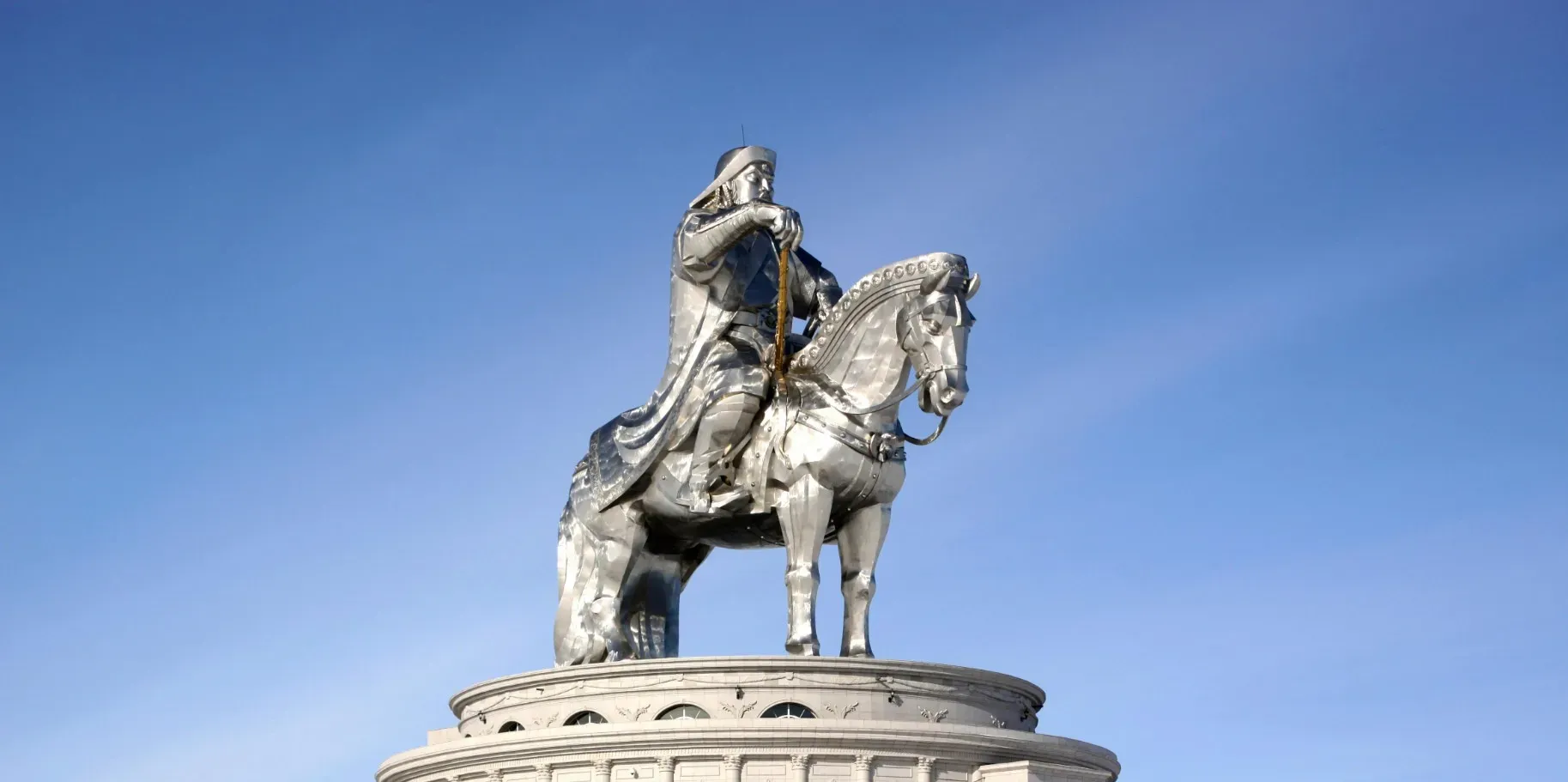
Two hundred and fifty tons of stainless steel form the 50-meter Genghis Khan Statue Complex, rising above the open steppe 54 kilometers east of Ulaanbaatar. Visitors climb through the monument's interior to reach an observation deck positioned directly on the horse's head.
Two hundred and fifty tons of shimmering stainless steel dominate the skyline at Tsonjin Boldog. The Genghis Khan Statue Complex features a 40-meter equestrian figure resting on a 10-meter circular visitor center, bringing the total height to 50 meters. Thirty-six columns support the base, representing the lineage of Khans from Genghis to Ligdan. The structure commands a 212-hectare site on the open Mongolian steppe at an elevation of 1,300 meters, located 54 kilometers east of Ulaanbaatar in Tuv Province.
Visitors enter the ground floor to find a massive, 9-meter-tall traditional Mongolian boot. Craftsmen constructed this giant footwear using more than 200 cowhides. A 5-meter replica of a golden whip hangs nearby, referencing the site's founding legend. The lower levels house an archaeological museum displaying Bronze Age tools and Hunnu-era artifacts. Guests pay a 20,000 MNT entrance fee to access these exhibits. A restaurant on the second floor serves traditional Mongolian and European cuisine.
The main attraction requires ascending through the monument's interior. An elevator carries visitors up through the horse's body, stopping at the chest. Guests then climb a narrow set of stairs up the horse's neck to reach an observation deck positioned directly on the animal's head. The platform provides a 360-degree view of the surrounding plains and the Tuul River valley. Wind speeds increase significantly at this 50-meter height, requiring heavy layers even during the summer months. The stainless steel walkways freeze over between November and March, making the final ascent highly slippery.
Most travelers reach the site by hiring a private taxi from Ulaanbaatar city center. The 54-kilometer drive takes approximately one hour and costs between 80,000 and 100,000 MNT. Drivers typically wait for two hours while guests explore the complex before providing the return trip. Budget-conscious visitors can take Bus XO 5-1 from the Officers' Palace to Nalaikh for 500 MNT, then hire a local taxi for the final stretch at a cost of 15,000 MNT. Guided day tours ranging from $45 to $120 USD often bundle the statue with a visit to Gorkhi-Terelj National Park, located just 30 minutes away.
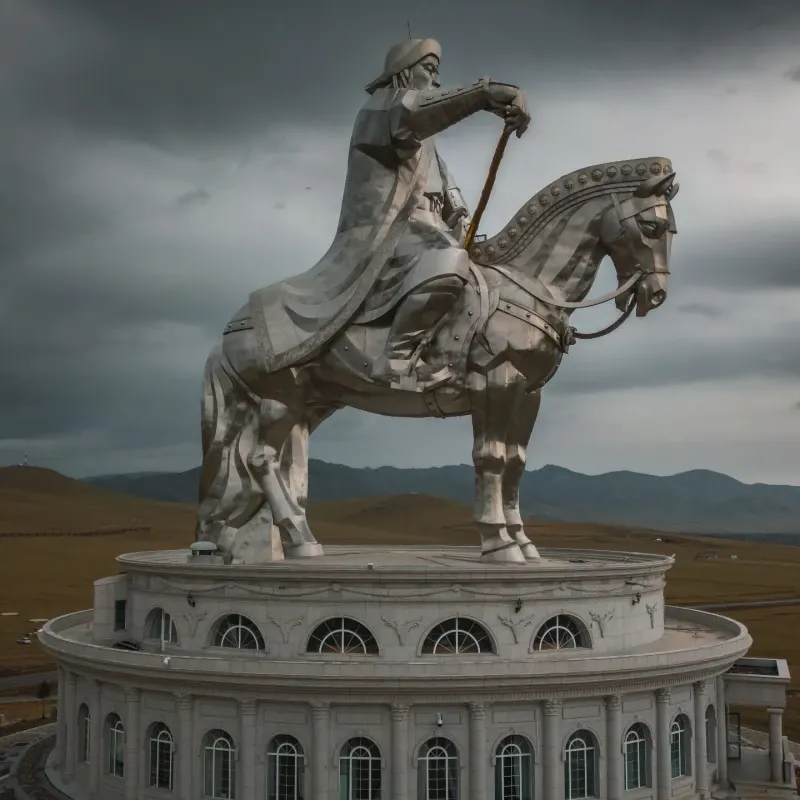
The location at Tsonjin Boldog connects directly to a 12th-century legend regarding the founder of the Mongol Empire. In 1177 AD, a young Temujin—who would later become Genghis Khan—was returning from a meeting with his ally Toiril Khan. He found a golden whip lying on the ground at this exact spot. Mongolians consider finding a whip a sign of good fortune and destiny. Temujin interpreted the discovery as a lucky omen, preceding his successful campaigns to unite the nomadic tribes and establish the empire in 1206.
Architect J. Enkhjargal and sculptor D. Erdenebileg designed the massive equestrian monument to commemorate the 800th anniversary of the founding of the Mongol Empire. The Genco Tourism Bureau funded the $4.1 million project. Construction crews broke ground in the mid-2000s, assembling the 250-ton stainless steel exterior piece by piece over a reinforced steel frame. The team completed the main structure in 2008, establishing it as the world's largest equestrian statue.
The site evolved into a major cultural hub over the following decade. Management expanded the underground museum to include extensive exhibits on the Xiongnu (Hunnu) empire and everyday nomadic life. Local Kazakh eagle hunters and camel herders established a permanent presence in the parking area, charging small fees for visitors to hold golden eagles or ride camels. As of 2026, the complex is undergoing targeted renovations, which occasionally limit access to specific museum wings. Check the operational status of the internal elevator upon arrival, as mechanical issues force visitors to climb the entire interior staircase.
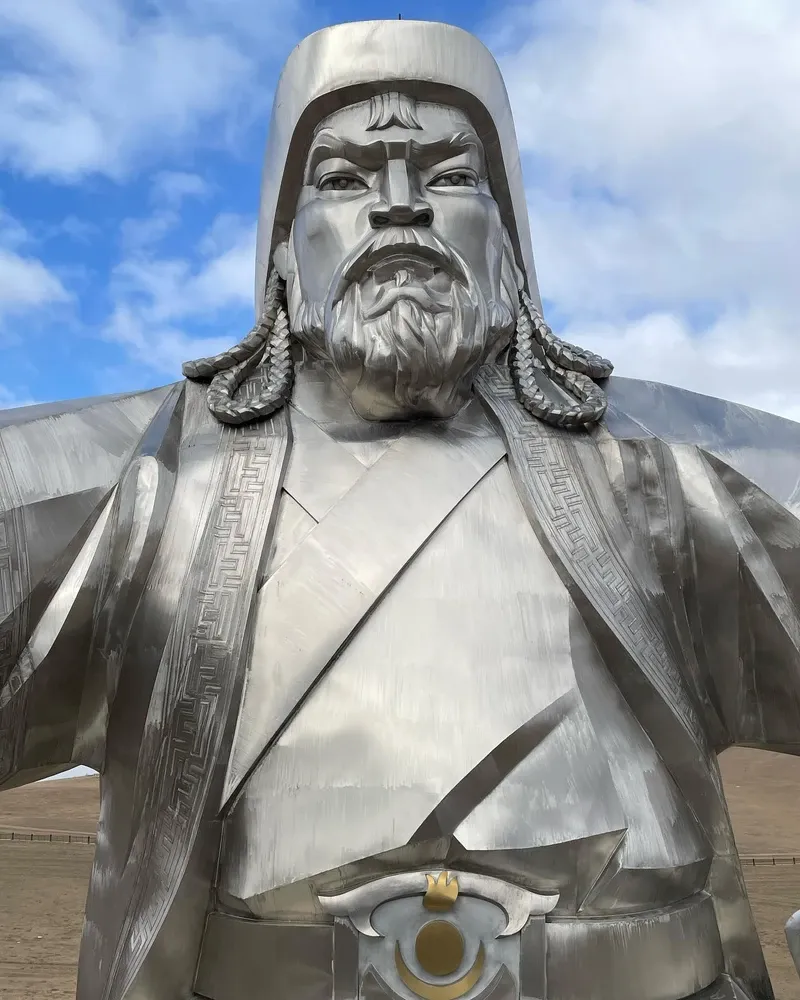
The monument consists of two distinct architectural sections: the 10-meter-high circular base and the 40-meter-tall equestrian statue. Thirty-six columns ring the exterior of the base, holding up the main platform. The statue itself faces precisely east. This orientation points toward Khentii Province, the documented birthplace of Genghis Khan. The sheer scale of the structure requires a massive internal steel skeleton to support the outer shell against the high winds of the steppe.
Two hundred and fifty tons of stainless steel plating cover the horse and rider. The metal reflects the harsh Mongolian sunlight, making the structure visible from kilometers away across the flat terrain. Inside, the engineering accommodates an elevator shaft and multiple staircases. The elevator ascends vertically through the horse's front legs and chest, terminating just below the neck. Visitors must use their physical strength to climb the remaining narrow stairs to the top.
The observation deck rests between the horse's ears. Visitors emerge from a doorway in the horse's mane and walk along the snout. The steel surface here is exposed to extreme weather conditions. Temperatures drop below -30°C in January, coating the metal deck in a thick layer of frost. Visitors must grip the safety railings tightly, as the open steppe funnels high-velocity winds directly into the structure. The 9-meter boot inside the lobby mirrors this massive scale, utilizing 200 cowhides to accurately replicate traditional Mongolian footwear stitching and design.
The 212-hectare complex sits within a broader network of historical and natural sites. Gorkhi-Terelj National Park lies 30 minutes away, offering alpine scenery and rock climbing. Turtle Rock, a massive natural granite formation, sits 40 minutes from the statue. Visitors often combine the statue with a trip to the Aryabal Meditation Temple, located 50 minutes away, which features 108 steps representing an elephant's trunk. The 13th Century Complex, a living history museum with six different medieval camps, is a 45-minute drive from the monument.
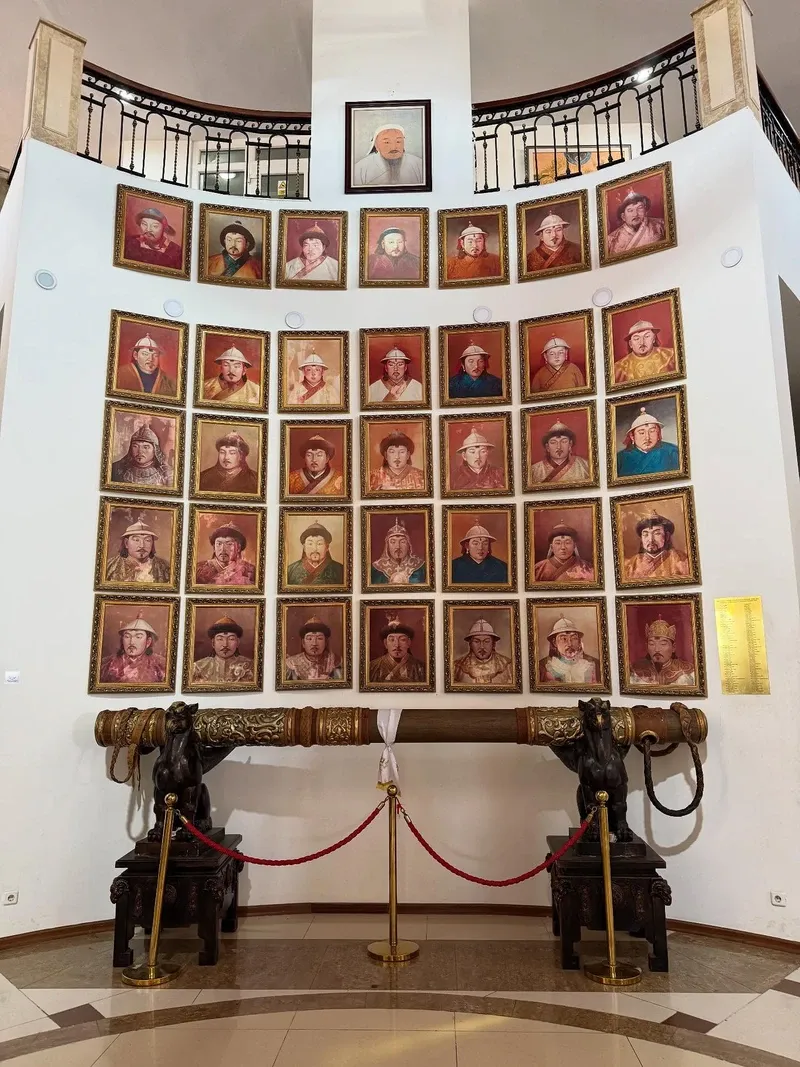
The Genghis Khan Statue Complex operates as a physical anchor for Mongolian national identity. Following decades of Soviet influence during which public veneration of Genghis Khan was suppressed, the 2008 monument marked a public reclamation of the country's founding figure. The statue portrays him not as a conqueror, but as a visionary leader holding the symbolic golden whip that foretold his rise to power. The 5-meter golden whip replica inside the visitor center reinforces this narrative of destiny and leadership.
The 36 columns surrounding the base represent the unbroken line of Khans from Genghis to Ligdan Khan, mapping out centuries of imperial history. Local visitors frequently dress in traditional deels to take family photographs inside the rotunda, treating the site as a civic monument. Children interact with the history through the giant boot display and the armor exhibits in the underground museum.
Custom dictates that visitors walk clockwise around religious and significant monuments in Mongolia. While the statue is secular, many locals apply this Buddhist practice when navigating the circular base. The monument grounds also host traditional activities, bridging the gap between modern engineering and nomadic heritage. Visitors regularly interact with Kazakh eagle hunters in the parking area, though tourists should confirm prices before handling the birds to avoid common overcharging scams.
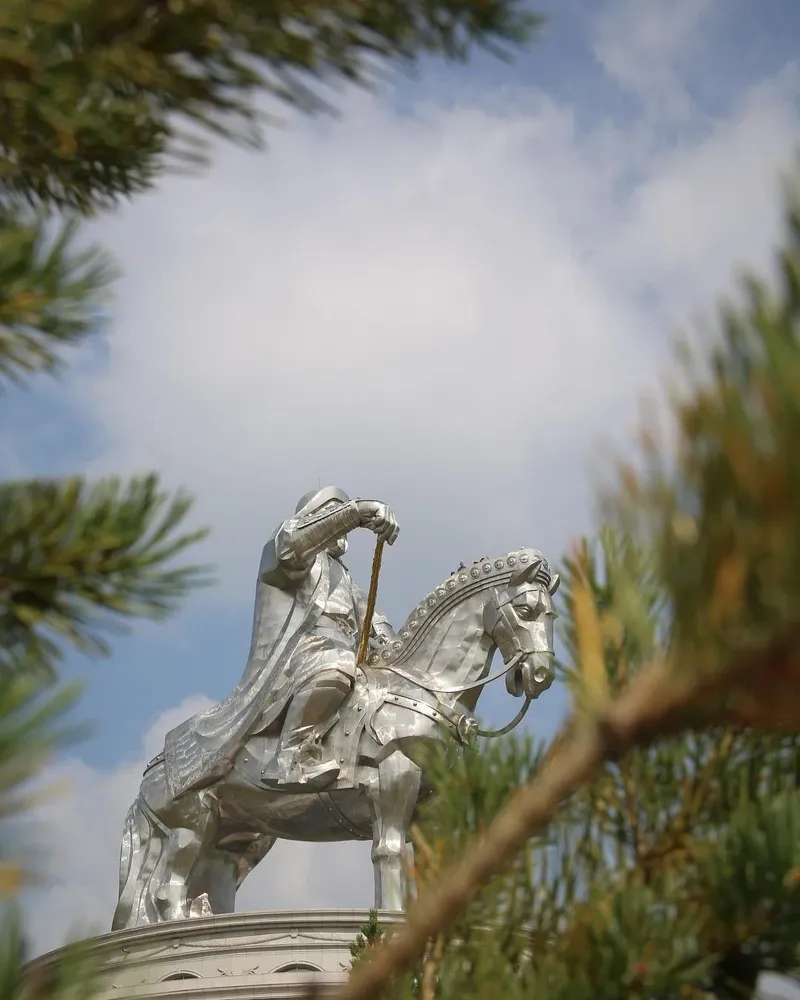
The statue faces exactly east toward Khentii Province, the documented birthplace of Genghis Khan.
Craftsmen used over 200 cowhides to construct the 9-meter-tall traditional Mongolian boot displayed in the lobby.
The base features exactly 36 columns to represent the 36 historical Khans of the Mongol Empire.
The site marks the exact spot where Temujin supposedly found a golden whip in 1177 AD.
Visitors can hold live golden eagles handled by local Kazakh hunters directly in the parking lot.
The entire 250-ton stainless steel structure cost $4.1 million USD to build in 2008.
Winter temperatures at the statue regularly drop below -30°C, completely freezing the outdoor observation deck.
Yes, the base houses a museum, and an elevator takes you up to the horse's chest. From there, stairs lead to an observation deck on the head.
The complex is located 54 kilometers east of the city center. The drive takes approximately one hour by private taxi.
No direct public bus exists. You must take Bus XO 5-1 to Nalaikh for 500 MNT, then hire a local taxi for the remaining distance.
Tickets cost 20,000 MNT per person. This grants access to the museum, the giant boot exhibit, and the observation deck.
The columns stand for the 36 historical Khans of the Mongol Empire. The lineage starts with Genghis Khan and ends with Ligdan Khan.
Legend states that Genghis Khan found a golden whip at this exact location in 1177 AD. Finding a whip is considered a powerful omen of good fortune in Mongolian culture.
The site remains open year-round from 10:00 AM to 6:00 PM. However, the outdoor stainless steel walkways become dangerously slippery with ice between November and March.
The equestrian statue measures 40 meters tall. It sits on a 10-meter-high visitor center, bringing the total height to 50 meters.
Drone photography requires advance permission from site management. Unauthorized drones are typically grounded by security staff.
Visitors can explore an underground Hunnu-era museum, rent traditional royal costumes for photos, and ride camels in the parking area.
Browse verified tours with free cancellation and instant confirmation.
Find Tours